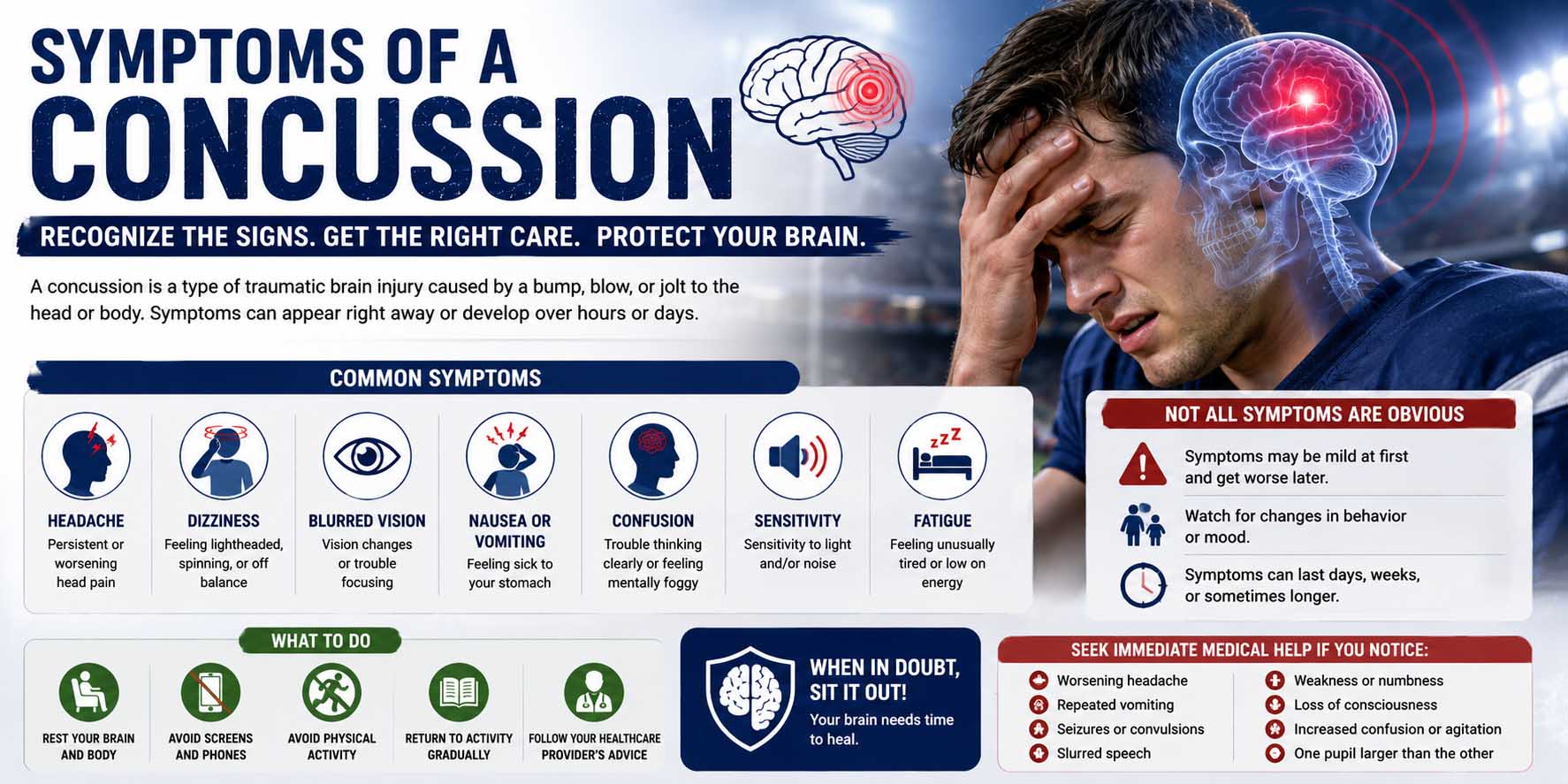
A concussion can happen after a fall, sports collision, car crash, or other force that makes the brain move rapidly inside the skull. The symptoms of a concussion may include headache, dizziness, nausea, confusion, balance problems, memory difficulties, and sensitivity to light or noise. However, symptoms vary widely, and some do not appear immediately after the injury.
Although a concussion is often described as a “mild” traumatic brain injury (TBI), that term refers to the initial injury classification. It does not mean symptoms should be ignored.
You also do not need to lose consciousness to have a concussion. In fact, many people remain awake throughout the event.
What Are the Symptoms of a Concussion?
People asking what are the symptoms of a concussion often expect one obvious warning sign. In reality, a concussion can affect how you feel, think, sleep, and function physically.
Common symptoms include:
- Headache or pressure in the head
- Dizziness
- Balance difficulties
- Nausea or vomiting
- Blurred or double vision
- Sensitivity to light
- Sensitivity to noise
- Feeling mentally “foggy”
- Difficulty concentrating
- Memory problems
- Slower thinking or responses
- Irritability or unusual emotional changes
- Fatigue or low energy
- Sleeping more or less than usual
- Difficulty falling asleep
Some people notice several symptoms immediately. Others develop symptoms gradually over the following hours.
Therefore, anyone who has experienced a significant head impact should pay attention to changes afterward, even if they initially feel relatively normal.
Early Symptoms of a Mild Concussion
The symptoms of a mild concussion can be subtle. For example, a person may simply feel dazed, unusually tired, slightly dizzy, or slower than normal.
Headache is especially common. However, not every headache after an injury means a concussion, and headache severity alone cannot tell you how serious a head injury is.
Although general advice about how to get rid of a headache can be useful for ordinary headaches, a new headache after a significant blow to the head should be treated differently. Instead of simply trying to suppress the pain, watch for other symptoms and seek medical advice when appropriate.
Other early changes may include difficulty remembering what happened immediately before or after the injury. Likewise, someone may repeatedly ask the same question or have trouble following a conversation.
Physical Symptoms
Physical effects often include headache, dizziness, nausea, vision changes, and poor balance.
Some people also feel unusually sensitive to normal lights or sounds. Meanwhile, physical activity may temporarily make symptoms more noticeable.
Neck discomfort can occur after the same incident that caused the concussion, especially after a fall, collision, or sudden acceleration and deceleration. Because neck injuries and concussions can produce overlapping complaints such as headache and dizziness, a clinician may need to assess both.
Thinking and Memory Changes
Concussion can temporarily affect cognitive function.
A person may struggle to concentrate on work, follow a long conversation, remember recent information, or process information at their usual speed.
For example, reading several pages may suddenly feel exhausting. Likewise, completing familiar tasks may require more concentration.
These changes can be frustrating, but they often improve as recovery progresses.
Emotional and Sleep Changes
Mood changes can also occur.
Some people become more irritable, anxious, emotional, or easily frustrated. Others simply report that they do not feel like themselves.
Sleep may change as well. A person may sleep more than usual, have difficulty falling asleep, or experience disrupted sleep.
Because these effects can be less visible than a physical injury, family members may notice behavioral changes before the injured person recognizes them.
Symptoms That Need Emergency Medical Attention
Most concussions are not life-threatening, but a more serious brain injury can initially resemble a concussion.
Therefore, emergency warning signs should never be ignored.
Seek emergency medical care after a head injury if a person develops signs such as:
- A headache that gets progressively worse
- Repeated vomiting
- Seizures or convulsions
- Increasing confusion or unusual behavior
- Severe agitation
- Increasing drowsiness or inability to wake normally
- Slurred speech
- Weakness, numbness, or reduced coordination
- Loss of consciousness, especially prolonged or concerning episodes
- Increasing difficulty recognizing people or places
Emergency assessment may also be appropriate after significant head trauma based on the mechanism of injury, age, medications, or medical history.
For instance, people taking anticoagulant or certain antiplatelet medicines may need a lower threshold for medical evaluation after head trauma because of bleeding risk.
The CDC’s concussion signs and symptoms guidance provides more information about common symptoms and danger signs that need emergency medical attention.
Symptoms of a Concussion in a Child
Recognizing symptoms of a concussion in a child can be harder because younger children may not know how to describe dizziness, confusion, or visual changes.
Older children and teenagers may report symptoms similar to adults, such as headache, nausea, concentration difficulties, or sensitivity to light.
In younger children, caregivers may instead notice:
- Unusual irritability
- More crying than normal
- Changes in eating
- Loss of interest in favorite activities
- Unsteady walking
- Changes in sleep
- Appearing dazed
- Reduced energy
- Vomiting
- Behavioral changes
Parents and caregivers should seek medical advice when a child develops concerning symptoms after a head injury.
Meanwhile, emergency warning signs such as seizures, worsening confusion, difficulty waking, repeated vomiting, significant weakness, or deteriorating responsiveness require urgent assessment.
Concussion Without Passing Out: How to Recognize the Symptoms
Yes. Loss of consciousness is not required for a concussion diagnosis.
This misconception sometimes causes people to dismiss injuries because they remained awake. However, a person can talk, walk, and remember the incident while still developing concussion symptoms.
Likewise, someone may initially appear fine before headache, dizziness, mental fog, or other problems emerge.
For that reason, the hours after an injury matter.
Observation does not mean someone must be kept awake continuously. Instead, follow the advice given by a healthcare professional regarding sleep and monitoring after the injury.
How Doctors Diagnose a Concussion
There is no single blood test, scan, or symptom that confirms every concussion.
Instead, healthcare professionals generally consider how the injury happened, the symptoms that followed, and findings from a neurological and physical examination.
A clinician may assess orientation, memory, concentration, balance, coordination, eye movements, strength, sensation, and other neurological functions.
A broader head to toe assessment may also be relevant after a fall, collision, or accident because the same event can injure areas beyond the head.
Doctors do not routinely need CT or MRI scans to diagnose an uncomplicated concussion. However, imaging may be used when there is concern about bleeding, a skull injury, or another structural problem.
Therefore, a normal scan does not necessarily mean a person did not have a concussion.
Concussion Headache vs. Other Headaches
Headaches have many causes, so context matters.
After a concussion, headache may feel like pressure, aching, throbbing, or a migraine-like headache. Meanwhile, neck injury from the same event can also contribute to head pain.
Someone whose head hurts when i cough may be dealing with a different headache pattern altogether. However, a new or worsening headache after trauma deserves assessment based on the injury and accompanying symptoms rather than comparison with unrelated headache types.
Pay particular attention when headache steadily worsens or appears with repeated vomiting, confusion, unusual drowsiness, weakness, or other neurological changes.
Those combinations warrant urgent medical attention.
What to Do After a Suspected Concussion
After a suspected concussion, stop activities that could lead to another head impact.
An athlete, for example, should not return to play on the same day when concussion is suspected. Instead, they should receive appropriate evaluation and follow a medically guided return-to-sport process.
During the first day or two, relative rest is generally preferred over prolonged strict bed rest. That means reducing activities that clearly worsen symptoms while still allowing light daily activity as tolerated and advised.
Screens, reading, bright environments, or demanding mental tasks may temporarily aggravate symptoms in some people. Therefore, adjust these activities based on how you feel rather than automatically eliminating them for a long period.
Alcohol and recreational drugs should be avoided during early recovery because they can affect judgment, sleep, balance, and symptom interpretation.
Before taking medicine for headache after a head injury, consider asking a healthcare professional which option is appropriate, particularly if the injury has not yet been assessed.
Returning to School, Work, and Exercise
Recovery does not always require waiting until every symptom disappears before resuming all normal activities.
Instead, many people gradually return to school, work, and light physical activity while keeping symptoms manageable.
Students may temporarily benefit from shorter school days, additional breaks, reduced assignments, or extra time for tests. Likewise, adults may need adjustments to screen time, workload, or physically demanding duties.
Light aerobic activity can sometimes become part of recovery when it does not substantially worsen symptoms. However, contact sports and activities with a risk of another head impact require greater caution.
A healthcare professional can help determine when it is safe to progress.
How Long Do Concussion Symptoms Last?
Many people improve over days to a few weeks, while others experience symptoms for longer. Age, previous concussions, symptom severity, other injuries, and individual health factors can influence recovery.
Persistent symptoms may include headache, dizziness, fatigue, concentration problems, sleep disturbances, or sensitivity to light and sound.
If symptoms are not improving as expected, follow up with a healthcare professional. They can check for other contributing problems and recommend targeted care when appropriate.
Symptoms in another body area should also be assessed in context. For instance, left arm pain after an accident could reflect a separate musculoskeletal injury rather than the concussion itself, while certain combinations of arm discomfort and other symptoms may require urgent medical evaluation.
Common Concussion Myths
“You Must Be Knocked Unconscious.”
False. Most concussions do not require loss of consciousness.
“A Normal CT Scan Rules Out Concussion.”
Not necessarily. CT scans are mainly used to look for structural problems such as bleeding or fractures in appropriate situations. Concussion can occur without abnormalities on routine imaging.
“You Should Stay in a Dark Room Until Every Symptom Disappears.”
Prolonged complete isolation and inactivity are generally not recommended for routine concussion recovery. Instead, current management commonly emphasizes brief relative rest followed by gradual activity that does not substantially worsen symptoms.
“Once You Feel Better, You Can Immediately Return to Sports.”
Not necessarily. Returning too quickly creates a risk of another injury. Athletes should follow a stepwise return-to-sport process and appropriate medical guidance.
FAQs About Concussion Symptoms
How Quickly Do Concussion Symptoms Appear?
Some symptoms appear immediately, while others become noticeable over the next several hours. Therefore, continued observation after a significant head injury can be useful.
Can You Have a Concussion and Feel Fine?
Yes. Some people initially feel normal and later notice headache, dizziness, concentration problems, fatigue, or other symptoms.
Can a Concussion Cause Nausea?
Yes. Nausea can occur after a concussion, and some people vomit. However, repeated vomiting after a head injury is a warning sign that requires urgent medical assessment.
Can Concussion Symptoms Get Worse Before They Get Better?
Symptoms may fluctuate, especially when physical or mental activity increases. However, progressively worsening symptoms after a head injury can signal a more serious problem and should receive prompt medical attention.
Should You Sleep After a Concussion?
Sleep itself is generally part of recovery, and the old rule that everyone with a concussion must stay awake is misleading. However, a person with concerning symptoms should first receive appropriate medical evaluation, and caregivers should follow the clinician’s monitoring instructions.
When to See a Doctor for Concussion Symptoms After a Head Injury
Seek medical evaluation when concussion is suspected, particularly when symptoms persist or the injury circumstances are concerning. Emergency warning signs such as worsening headache, repeated vomiting, seizures, increasing confusion, significant weakness, or difficulty waking require urgent care.
Take Head-Injury Symptoms Seriously
The symptoms of a concussion can range from an ordinary-looking headache or mild dizziness to noticeable problems with balance, memory, sleep, and concentration. Since symptoms can develop gradually, feeling fine immediately after a hit does not always mean there is no injury.
After a suspected concussion, avoid activities that could cause another head impact and monitor for changes. Then, seek professional medical guidance when symptoms persist, interfere with normal activities, or follow a concerning injury.
Above all, worsening neurological symptoms after head trauma should not be managed at home. Prompt medical assessment can distinguish an uncomplicated concussion from injuries that require urgent treatment.